
7 play gyms tested. 1 pragmatic pick. Here’s what actually engages your baby.
A play gym is the first toy your baby will actually use, and
for the first three months of life, it might be the only toy that
gets meaningful engagement. Babies lie on their backs, stare at
dangling objects, and slowly learn that their flailing arms can
actually make things happen. It’s cause-and-effect training
disguised as cute.
The problem is the market is flooded with options ranging from
$20 plastic setups to $150 Montessori-designed wooden arches,
and it’s genuinely hard to know what matters. Does your baby care
about organic cotton? No. Does your baby care about a kick piano?
Surprisingly, yes. Do YOU care about whether the gym looks like
a Fisher-Price explosion in your living room? Almost certainly.
I tested seven play gyms across the spectrum — from
developmental Montessori designs to battery-powered musical
setups to convertible ball pits — and the answer to “which
one should I buy?” depends entirely on what you value: aesthetics,
engagement, longevity, or price. Here’s how each one performed
in a real household with a real baby who has strong opinions about
everything.
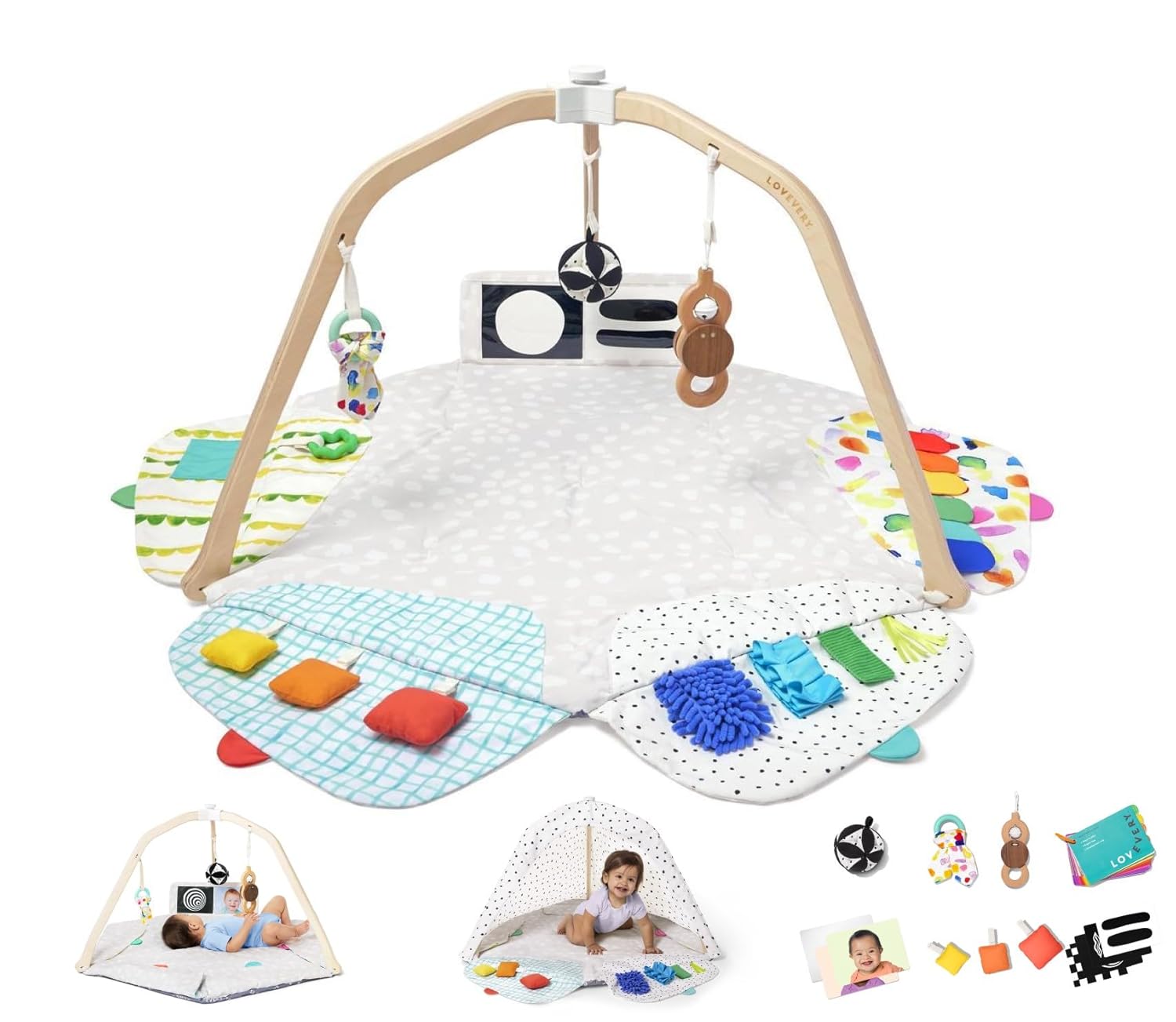
Lovevery The Play Gym
Montessori-inspired play gym with developmental zones and sustainably sourced materials.
Best overall — research-backed developmental design from newborn through toddler

Fisher-Price Baby Playmat Deluxe Kick & Play Piano Gym
Classic piano gym with kick-activated music, lights, and 5 activity stages.
Best interactive — kick-activated piano keeps babies engaged for months
What to Look For in a Play Gym
Developmental Design. The best gyms have toys
at varying heights and distances, encouraging your baby to track,
reach, and eventually grasp. High-contrast patterns matter in the
first 8 weeks when vision is limited. After that, variety in
textures (crinkle, rattle, mirror) keeps engagement going.
Mat Quality. Your baby will spend hours on
this thing. Thick padding matters for comfort and tummy time. A
machine-washable mat is non-negotiable — between spit-up,
drool, and diaper incidents, you’ll wash it weekly.
Longevity. A gym that works for 3 months is
a mediocre investment. A gym that converts from lying-down play
to tummy time to sitting play to toddler use is dramatically
better value. Look for adjustable arches, detachable toys, and
multi-mode designs.
Aesthetics vs. Engagement. This is the
eternal tension. Wooden Montessori gyms look gorgeous in your
living room. Plastic gyms with lights and music look like a
carnival. Babies generally prefer the carnival. You have to decide
how much that matters to you.
Portability. If you want to move the gym
between rooms (or to grandma’s house), foldability matters.
Wooden frame gyms are sturdy but don’t collapse. Fabric gyms
fold flat in seconds.
All 7 Play Gyms & Activity Centers Reviewed
1. Lovevery The Play Gym Pragmatic Pick
Best overall — research-backed developmental design from newborn through toddler
The Lovevery Play Gym is what happens when child development
researchers design a toy instead of a marketing department. Each
zone of the gym targets a specific developmental milestone:
high-contrast cards for early visual tracking, a wooden batting
ring for reaching practice, an organic cotton teether for oral
exploration, and a Montessori ball for tactile development.
The wooden arches are gorgeous and sturdy — they won’t
tip or wobble when your baby starts pulling on things with
surprising force. The organic cotton mat is soft, thick enough
for comfortable tummy time, and machine washable (the cover
zips off). The included stage-based play guides actually help
you understand what your baby is working on developmentally,
which makes playtime feel intentional rather than aimless.
The trade-off is clear: it’s expensive, it doesn’t fold flat,
and there are no lights or sounds to provide that easy
entertainment dopamine hit. If your baby is one who needs
maximum stimulation to stay engaged, the Lovevery might feel
understimulating. But for parents who want a beautiful, research-backed
play space that encourages open-ended exploration, nothing else
comes close.
| Type | Developmental Play Gym |
| Age Range | 0–12+ months |
| Included Toys | 5 developmental zones, organic teether, Montessori ball |
| Mat Material | Organic cotton, sustainably sourced wood |
| Machine Washable | Yes — mat cover removable |
| Foldable | No — wooden frame |
| Music / Lights | No — sensory-focused (no batteries) |
| Price Range | $$$ |
What We Like
- Research-backed developmental zones for each growth stage
- Organic cotton mat and sustainably sourced wooden arches
- No batteries — encourages open-ended sensory play
- Converts from gym to play space to fort as baby grows
- Beautiful design that doesn’t look like a toy explosion
Worth Noting
- Most expensive play gym by a significant margin
- Wooden frame doesn’t fold flat for storage
- Fewer flashy features may bore stimulation-seeking babies
2. Fisher-Price Baby Playmat Deluxe Kick & Play Piano Gym Runner-Up
Best interactive — kick-activated piano keeps babies engaged for months
The Fisher-Price Kick & Play Piano Gym has been a bestseller
for years, and the reason is simple: babies go absolutely bonkers
for the piano. They kick it, it plays music. They kick it again,
different music. The cause-and-effect feedback loop is immediate
and satisfying, and you’ll watch your baby figure it out in
real time. It’s genuinely magical the first time.
The 5 play stages extend usability from newborn (lying down,
batting at toys) through toddler (sitting and playing the
detachable piano). The 65+ songs and sounds seem like overkill
until you realize your baby wants novelty, and having variety
matters. The detachable piano becomes a standalone toy that my
kid played with well past the gym stage.
The downsides are aesthetic and philosophical. It’s plastic,
it’s primary-colored, it’s battery-powered, and it can be
overstimulating for very young newborns. If you care about
your living room looking like a nursery catalog vs. a Toys R Us,
this isn’t the gym for you. But if you want raw engagement per
dollar, nothing in this roundup beats the Piano Gym.
| Type | Musical Activity Gym |
| Age Range | 0–36 months |
| Included Toys | Piano keyboard, mirror, 5 hanging toys, teether |
| Mat Material | Polyester |
| Machine Washable | Yes — mat only |
| Foldable | Yes — piano detaches |
| Music / Lights | Yes — piano with lights, 65+ songs/sounds |
| Price Range | $ |
What We Like
- Kick-activated piano teaches cause and effect early
- 5 play stages from tummy time to sit-and-play piano
- 65+ songs, sounds, and phrases for extended engagement
- Detachable piano is a standalone toy for toddlers
- Most affordable full-featured gym
Worth Noting
- Battery-powered — ongoing cost and electronic waste
- Plastic-heavy construction
- Can be overstimulating for very young newborns

3. Blissful Diary Baby Play Gym Mat with 6 Detachable Toys
Best nursery-friendly — neutral design with plush padding
The Blissful Diary gym occupies the sweet spot between the
Lovevery’s premium aesthetic and the Fisher-Price’s
budget-friendly engagement. The neutral colors (think creams,
sage greens, soft browns) blend into nursery decor without
screaming “baby toy,” and the thick padded mat is genuinely
comfortable for extended tummy time sessions.
The 6 detachable toys include a crinkle element, a rattle,
and a mirror — the holy trinity of infant entertainment.
They clip on and off easily, which means you can rotate them
or use them as standalone toys during car seat time. The mat
is machine washable, which you’ll appreciate after the first
spit-up incident.
Where the Blissful Diary falls short is in longevity and
developmental intentionality. There’s no multi-stage design,
no educational framework, and the arches are functional but
basic. It’s a good play gym for the 0-8 month window, but
you won’t be using it creatively beyond that. For the price,
it’s solid. Just don’t expect Lovevery-level depth.
| Type | Sensory Play Gym |
| Age Range | 0–12 months |
| Included Toys | 6 detachable hanging toys (crinkle, rattle, mirror) |
| Mat Material | Plush polyester, thick padding |
| Machine Washable | Yes — mat is machine washable |
| Foldable | Yes |
| Music / Lights | No — sensory toys only |
| Price Range | $$ |
What We Like
- Neutral aesthetic fits any nursery decor
- Thick padded mat is comfortable for extended play
- 6 detachable toys can be used separately
- Machine washable mat
- Good mid-range price
Worth Noting
- Less developmental research behind design vs Lovevery
- Arch quality is basic
- Limited play stages compared to Fisher-Price
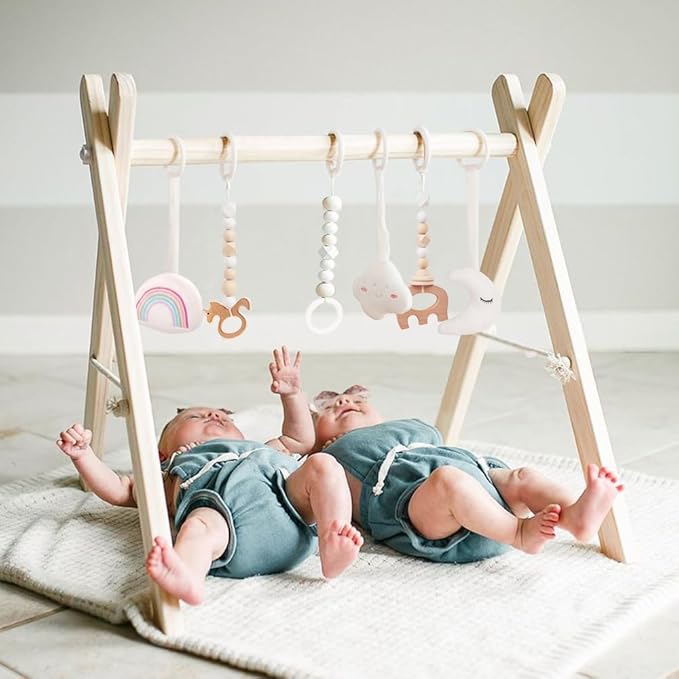
4. Mallify Wooden Baby Gym with 6 Toys
Best Lovevery alternative — wooden aesthetic at a fraction of the price
The Mallify Wooden Gym is the answer to the question “I love
the Lovevery aesthetic but not the Lovevery price.” The
Scandinavian-style wooden A-frame looks beautiful, the non-toxic
finish is reassuring, and the 6 hanging toys (a mix of wooden
shapes and fabric elements) provide enough visual and tactile
stimulation for the early months.
The critical detail: no mat is included. You use your own
blanket, playmat, or rug underneath. This is either a feature
(use whatever mat you already have and like) or a bug (you
expected a complete setup for the price). The foldable legs are
a genuine advantage for storage — it flattens down and
slides behind a couch.
The limitations are real: fewer toy attachment points than
the Lovevery, less developmental intentionality, and a shorter
usable window (once your baby starts pulling to stand, a
lightweight wooden frame becomes a tipping hazard). But as a
gorgeous, affordable gym for the first 8-10 months, the Mallify
delivers on aesthetics at a price that makes sense.
| Type | Wooden Play Gym |
| Age Range | 0–10 months |
| Included Toys | 6 hanging wooden and fabric toys |
| Mat Material | No mat included (frame only) |
| Machine Washable | N/A — wipe clean frame |
| Foldable | Yes — legs fold flat |
| Music / Lights | No — natural materials |
| Price Range | $ |
What We Like
- Beautiful Scandinavian-style wooden design
- Fraction of the Lovevery price for similar aesthetic
- Foldable legs for easy storage
- Non-toxic finishes
- Works with any blanket or mat you already own
Worth Noting
- No mat included — you need your own
- Wooden toys less varied than fabric/sensory options
- Limited hanging toy adjustability

5. TFDER Baby Gym Play Mat 8-in-1 with Washable Ball Pit
Most versatile — 8 configurations from gym to ball pit
The TFDER 8-in-1 is the Swiss Army knife of play gyms, and
like all Swiss Army knives, it does many things adequately
rather than one thing exceptionally. The core concept is clever:
fold the sides up and it’s a contained play area with raised
walls, fill it with the included balls and it’s a ball pit, lay
it flat and it’s a standard play gym, prop up sections for
tummy time support.
The ball pit mode is the standout — older babies (8+
months) who can sit independently go wild for it, and it extends
the usable life well past what a traditional gym offers. The
included piano attachment provides the same cause-and-effect
engagement as the Fisher-Price, though at lower quality.
The assembly is more involved than a standard gym, and the
“8 modes” marketing is generous — realistically, you’ll
use 3-4 configurations regularly. The balls also scatter across
your entire house within minutes of the first play session.
But for parents who want one product that transitions through
multiple stages, the TFDER offers genuine versatility at a
reasonable price.
| Type | Convertible Play Gym + Ball Pit |
| Age Range | 0–36 months |
| Included Toys | Hanging toys, balls, piano keyboard, mirror |
| Mat Material | Polyester with padding |
| Machine Washable | Yes — mat removable |
| Foldable | Yes — sides fold up/down |
| Music / Lights | Yes — piano attachment |
| Price Range | $$ |
What We Like
- 8 play configurations extend usable life significantly
- Ball pit mode is a hit with older babies
- Raised sides create a contained play area
- Includes piano, hanging toys, and balls
- Good value for the versatility
Worth Noting
- Jack-of-all-trades, master of none
- Assembly is more complex than basic gyms
- Ball pit balls are small and scatter everywhere

6. Ingenuity Keep Cozy 3-in-1 Vibrating Baby Bouncer & Rocker
Best hybrid — combines bouncer soothing with activity gym stimulation
The Ingenuity Keep Cozy is technically a bouncer/rocker with
an activity bar rather than a play gym, but it shows up in every
“best play gym” search, so it deserves honest evaluation. The
vibration setting is the headline feature — it genuinely
soothes fussy babies, and the slight bounce from baby’s own
movement adds a self-entertainment element.
The toy bar with 2 plush hanging toys provides some visual
stimulation, though it’s significantly less than what a
dedicated play gym offers (5-6 toys, varied textures, etc.).
The 3-in-1 design (bouncer, rocker, stationary seat) means
you’ll use it in the kitchen, the bathroom, wherever you need
baby contained and content while you do something with both
hands.
As a play gym replacement, it falls short. As a
complementary piece that gives you hands-free moments while
providing some stimulation, it’s excellent. Many parents end
up owning both a play gym (for dedicated floor play) and a
bouncer (for “I need to cook dinner” moments). At its low
price, the Ingenuity is a smart addition, not a
substitution.
| Type | Bouncer/Rocker + Activity Bar |
| Age Range | 0–18 months (40 lbs) |
| Included Toys | Removable toy bar with 2 plush toys |
| Mat Material | Plush seat pad |
| Machine Washable | Yes — seat pad removable |
| Foldable | Yes — lightweight fold |
| Music / Lights | Vibration mode (battery-powered) |
| Price Range | $ |
What We Like
- Vibration setting soothes fussy babies effectively
- 3-in-1: bouncer, rocker, and stationary seat
- Lightweight and easy to move room to room
- Removable toy bar for play stimulation
- Very affordable
Worth Noting
- Less floor play space than dedicated play gyms
- Only 2 hanging toys vs 5-6 on gym mats
- Vibration requires batteries

7. Tiny Love Gardens of Adventure
Best traditional gym — proven developmental design with adjustable arches
Tiny Love has been making developmental toys for decades, and
the Gardens of Adventure gym reflects that experience. The
adjustable arches can be repositioned for different play modes
(both arches up, one arch up for tummy time, both down for open
mat play), which gives it flexibility that fixed-arch gyms
lack.
The mix of sensory elements — crinkle leaves, rattling
bugs, a baby-safe mirror, and an electronic musical toy —
covers multiple engagement modes. The electronic attachment
plays music and lights when activated, splitting the difference
between the battery-free Lovevery and the full-on Fisher-Price
piano experience.
The design leans “colorful toy” rather than “nursery decor,”
which may or may not matter to you. The mat is machine washable
and adequately padded. The price sits in the mid-range. If
you want a traditional play gym from a trusted developmental
toy brand without the Lovevery price tag or the Fisher-Price
plastic aesthetic, the Tiny Love is a reasonable middle
ground.
| Type | Developmental Play Gym |
| Age Range | 0–12 months |
| Included Toys | Multiple hanging toys, crinkle elements, mirror |
| Mat Material | Polyester with padded mat |
| Machine Washable | Yes — mat removable |
| Foldable | Yes — arches detach |
| Music / Lights | Electronic musical toy attachment |
| Price Range | $$ |
What We Like
- Adjustable arches grow with baby’s development
- Mix of sensory elements (crinkle, rattle, mirror, music)
- Trusted Tiny Love developmental toy brand
- Open arch design allows easy access for tummy time
- Machine washable mat
Worth Noting
- Design is more “toy-like” than nursery-friendly
- Electronic toy requires batteries
- Mid-range price without premium materials
Why the Lovevery Play Gym Is the Pragmatic Pick
The Lovevery Play Gym wins because it’s the rare product that
satisfies both the parent and the baby. The developmental zones
are research-backed (Lovevery works with child development experts),
the organic cotton and wooden arches look beautiful in your home,
and the gym grows with your baby through multiple stages —
from batting at hanging toys to using the play cards to building
a fort with the included canopy.
Is it expensive? Absolutely. It’s the most expensive play gym
by a wide margin. But you’ll use it daily for 12+ months, it
doesn’t require batteries, and it doesn’t make you cringe every
time you look at your living room. The cost-per-use drops fast
when you’re logging hours every single day.
The Fisher-Price Piano Gym earns runner-up for a completely
different reason: raw engagement. The kick-activated piano is
genius — it teaches cause and effect, entertains for
remarkably long stretches, and the detachable piano becomes a
standalone toy for years. At a fraction of the Lovevery’s price,
it’s the pragmatic pick if your budget is tighter or you simply
don’t mind the aesthetic trade-off. Many parents end up owning
both.
Frequently Asked Questions
When should I start using a play gym with my baby?
You can introduce a play gym from birth. Newborns benefit from the high-contrast visual stimulation of hanging toys, even though they can't reach for them yet. By 2-3 months, babies start batting at toys, and by 4-5 months they're grabbing and pulling them. The play gym is also an excellent tummy time surface with toys positioned to motivate lifting the head. Most babies get the most engagement between 2 and 6 months.
How long do babies use play gyms?
Most babies actively use play gyms from about 1 month to 6-8 months. Interest typically peaks around 3-5 months when they can grab and manipulate the hanging toys. Once babies become mobile (crawling), they tend to move away from the gym rather than staying under it. Some play gyms convert into activity tables or tummy time props, extending their useful life. Budget about 5-7 months of active use when evaluating the cost.
Are wooden play gyms better than plastic ones?
Wooden play gyms are more aesthetically pleasing, more durable, and often use more natural materials — they look great in a living room and can be passed down to siblings. Plastic play gyms typically offer more interactive features: lights, music, piano keys, and electronic toys that respond to baby's touch. For pure developmental stimulation, the electronic features aren't necessary — simple hanging toys that baby can bat and grab provide the same fine motor benefits. Choose based on your priorities: aesthetics and longevity (wood) or interactive features (plastic).
Do play gyms help with baby development?
Yes. Play gyms support several developmental milestones: visual tracking (following hanging toys), hand-eye coordination (reaching and batting), fine motor skills (grasping and pulling), tummy time strength (lifting head to see toys), and cause-and-effect learning (hitting a toy makes it move or make sound). The key is age-appropriate stimulation — high-contrast patterns for newborns, crinkle and rattle textures for 2-3 months, and graspable toys for 4+ months.
Head-to-Head Comparisons
Want to see how any two stack up directly? Pick a matchup:
- Lovevery Play Gym vs Fisher-Price Piano Gym
- Lovevery Play Gym vs Blissful Diary Gym
- Lovevery Play Gym vs Mallify Wooden Gym
- Lovevery Play Gym vs TFDER 8-in-1 Gym
- Lovevery Play Gym vs Ingenuity Bouncer
- Lovevery Play Gym vs Tiny Love Gardens
- Fisher-Price Piano Gym vs Blissful Diary Gym
- Fisher-Price Piano Gym vs Mallify Wooden Gym
- Fisher-Price Piano Gym vs TFDER 8-in-1 Gym
- Fisher-Price Piano Gym vs Ingenuity Bouncer
- Fisher-Price Piano Gym vs Tiny Love Gardens
- Blissful Diary Gym vs Mallify Wooden Gym
- Blissful Diary Gym vs TFDER 8-in-1 Gym
- Blissful Diary Gym vs Ingenuity Bouncer
- Blissful Diary Gym vs Tiny Love Gardens
- Mallify Wooden Gym vs TFDER 8-in-1 Gym
- Mallify Wooden Gym vs Ingenuity Bouncer
- Mallify Wooden Gym vs Tiny Love Gardens
- TFDER 8-in-1 Gym vs Ingenuity Bouncer
- TFDER 8-in-1 Gym vs Tiny Love Gardens
- Ingenuity Bouncer vs Tiny Love Gardens
As an Amazon Associate and affiliate partner, New Pragmatic Dad earns from qualifying purchases. This doesn’t affect our recommendations — we only suggest products we’d buy ourselves.