
6 monitors tested. 1 pragmatic pick. Here’s what actually lets you sleep.
Baby monitors have evolved from simple audio walkie-talkies
into full surveillance systems that would make a CIA analyst
jealous. You can now watch your baby in 2K video, track their
heart rate with a sock, get AI-generated sleep reports, and
receive notifications if the room temperature shifts by a single
degree. Whether you need all of that is a different question
entirely.
The market splits into three camps: dedicated
monitors (camera + handheld screen, no Wi-Fi),
smart Wi-Fi cameras (stream to your phone,
cloud features), and wearable monitors (socks
or bands that track vitals). Each has genuine trade-offs. Dedicated
monitors are more secure and reliable but can’t be checked
remotely. Wi-Fi cameras offer flexibility but introduce hacking
risk and lag. Wearables provide peace of mind but can create
anxiety with false alarms.
I tested six monitors spanning all three categories. The
“best” monitor depends on what keeps you up at night —
literally. If it’s “can I see my baby?”, a dedicated screen
wins. If it’s “is my baby breathing?”, a wearable wins. If
it’s “how do I optimize my baby’s sleep?”, a smart camera wins.
Here’s how each one performs when it actually matters.
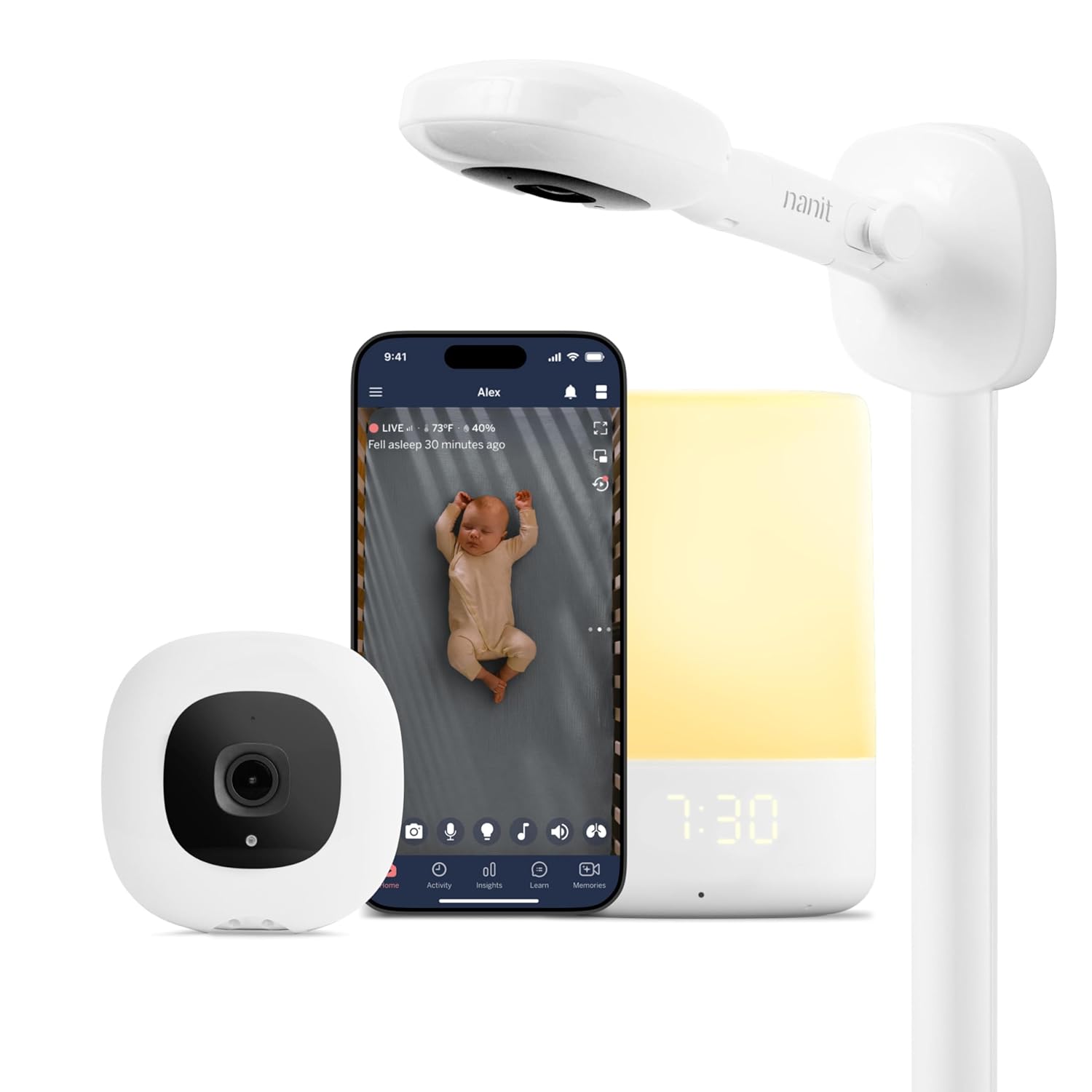
Nanit Nursery Bundle Smart Baby Monitor with Wall Mount
Smart HD camera with sleep tracking, breathing wear integration, and wall-mount design.
Best overall — HD video with AI-powered sleep analytics and breathing monitoring

Momcozy Video Baby Monitor 1080P 5" HD
No-Wi-Fi 1080p monitor with 5" HD screen, 2-way talk, and pan/tilt/zoom camera.
Best non-Wi-Fi — dedicated screen with no hacking risk and zero lag
What to Look For in a Baby Monitor
Video Quality & Night Vision. You’ll use
this monitor most at night, so night vision quality matters more
than daytime resolution. Look for infrared night vision that
shows clear detail without being so bright it disturbs your baby.
1080p is the sweet spot; 2K is nice but rarely necessary on a
5″ screen.
Wi-Fi vs. Dedicated Screen. Wi-Fi monitors
stream to your phone, which means you can check from anywhere.
But they depend on your internet connection (lag during outages),
and any Wi-Fi device is theoretically hackable. Dedicated-screen
monitors use encrypted radio signals, have zero lag, and can’t
be hacked remotely. The trade-off: you can only watch within
the signal range.
Subscription Costs. Smart monitors
increasingly hide features behind monthly subscriptions. Sleep
analytics, video history, and advanced alerts may require $5-15
per month. Calculate the annual cost and decide if those features
are worth it before the upfront purchase.
Sleep Tracking vs. Vitals Monitoring. Sleep
tracking (how long baby slept, wake windows) is useful data for
optimizing routines. Vitals monitoring (heart rate, blood oxygen)
provides medical-grade peace of mind. They’re different value
propositions. Sleep tracking helps you plan; vitals monitoring
helps you worry less (or more, depending on your anxiety
level).
False Alarm Management. Wearable monitors
that track vitals will occasionally trigger false alarms (sock
slipped, weak signal, movement artifact). For anxious parents,
a false alarm at 3 AM can create more stress than no monitor at
all. Consider your personal anxiety threshold when choosing
between camera-only and wearable options.
All 6 Baby Monitors Reviewed
1. Nanit Nursery Bundle Smart Baby Monitor with Wall Mount Pragmatic Pick
Best overall — HD video with AI-powered sleep analytics and breathing monitoring
The Nanit Pro’s wall-mount design is the first thing that
sets it apart. While other cameras sit on a shelf and show you
a side view of the crib, the Nanit mounts above and looks
straight down, giving you a bird’s-eye view of the entire sleep
surface. You can see exactly where your baby is, whether they’ve
rolled, and whether their face is clear — without any
blind spots.
The sleep tracking is where the Nanit justifies its price.
Using computer vision (not a wearable), it monitors your baby’s
breathing motion, sleep duration, and activity levels. The
morning sleep reports tell you exactly when your baby slept,
woke, and how their night compares to previous nights. Over
weeks, patterns emerge that help you adjust bedtime routines.
This is data-driven parenting at its most useful.
The subscription model is the sticking point. Basic monitoring
is free, but the detailed sleep analytics and video review
require Nanit Insights ($10/mo or $100/yr). The Breathing Wear
bands (~$25 each) are an ongoing cost as your baby outgrows
sizes. It adds up. But if you’re the kind of parent who wants
data to inform decisions (and you’re reading this review, so
you probably are), the Nanit’s ecosystem delivers more
actionable information than anything else on this list.
| Type | Smart Wi-Fi Camera + Wearable Integration |
| Video Resolution | 1080p HD |
| Display | Smartphone app (iOS/Android) |
| Night Vision | Yes — infrared |
| Two-Way Audio | Yes |
| Room Conditions | Yes — room conditions |
| Sleep Tracking | Yes — AI-powered sleep analytics |
| Range | Unlimited (Wi-Fi) |
| Subscription | Optional Nanit Insights ($10/mo or $100/yr) |
| Price Range | $$$ |
What We Like
- AI-powered sleep tracking with nightly sleep reports
- Breathing Wear integration monitors breathing motion
- Bird’s-eye wall mount provides full crib view
- 1080p HD video with crystal-clear night vision
- Split-screen support for multiple cameras
Worth Noting
- Requires Wi-Fi — no standalone monitor option
- Subscription needed for full sleep analytics
- Most expensive monitor system in this roundup
- Breathing Wear bands are an ongoing cost
2. Momcozy Video Baby Monitor 1080P 5" HD Runner-Up
Best non-Wi-Fi — dedicated screen with no hacking risk and zero lag
The Momcozy monitor is the anti-Nanit, and I mean that as a
genuine compliment. No Wi-Fi, no app, no subscription, no
account creation, no firmware updates at 2 AM. You plug in the
camera, turn on the monitor, and it works. The dedicated 5″ HD
screen shows your baby in 1080p, the infrared night vision is
clear, and the pan/tilt/zoom camera covers the entire room from
a single position.
The security argument is real. A dedicated monitor with
encrypted radio signal cannot be hacked from the internet.
Period. For parents who are uncomfortable with a Wi-Fi camera
in their baby’s room (and that’s a reasonable concern), the
Momcozy eliminates that anxiety entirely. The 1,000 ft range
covers any normal home, and the signal doesn’t depend on your
router working.
What you give up is smart features and remote access. No
sleep tracking, no breathing analytics, no checking on baby
from the office. The dedicated screen is another device to
charge and carry around the house. But for pure, reliable,
no-nonsense baby monitoring that works every time without
requiring your phone, an internet connection, or a monthly fee,
the Momcozy nails the fundamentals.
| Type | Dedicated Monitor (No Wi-Fi) |
| Video Resolution | 1080p HD |
| Display | 5″ HD dedicated screen |
| Night Vision | Yes — infrared |
| Two-Way Audio | Yes |
| Room Conditions | Yes — room temperature |
| Sleep Tracking | No |
| Range | 1,000 ft (line of sight) |
| Subscription | None required |
| Price Range | $$ |
What We Like
- No Wi-Fi needed — zero hacking risk
- 5″ HD dedicated screen doesn’t drain phone battery
- Pan/tilt/zoom camera covers the entire room
- No subscription fees ever
- 1,000 ft range for larger homes
Worth Noting
- No sleep tracking or smart analytics
- Can’t check remotely when away from home
- Dedicated screen is another device to carry

3. Infant Optics DXR-8 PRO Video Baby Monitor
Best lens system — interchangeable lenses for zoom, wide-angle, and optical clarity
The Infant Optics DXR-8 PRO was the #1 selling baby monitor
for years, and its unique selling point remains compelling: an
interchangeable optical lens system. The standard lens works for
most setups, a wide-angle lens captures more of the room, and
a zoom lens lets you get close-up detail from across the nursery.
It’s the only monitor that lets you change the optical
characteristics of the camera itself.
The FHSS encrypted signal is secure and consistent, the
Active Noise Reduction makes night vision clearer than most
competitors, and the brand’s track record gives it a reliability
reputation that newer brands haven’t earned yet. The 5″ IPS
display is bright and clear.
The 720p resolution is the elephant in the room. In 2026,
when competitors offer 1080p and 2K, 720p feels dated. On the
5″ screen it’s adequate, but you’ll notice the difference if
you’ve used a 1080p monitor. The interchangeable lenses are
also sold separately (~$10-15 each), which feels like it should
be included at this price. For reliability and the unique lens
system, the Infant Optics remains relevant. For resolution and
value, newer options have surpassed it.
| Type | Dedicated Monitor (No Wi-Fi) |
| Video Resolution | 720p HD |
| Display | 5″ IPS display |
| Night Vision | Yes — infrared with Active Noise Reduction |
| Two-Way Audio | Yes |
| Room Conditions | Yes — room temperature |
| Sleep Tracking | No |
| Range | 1,000 ft (FHSS encrypted) |
| Subscription | None required |
| Price Range | $$ |
What We Like
- Interchangeable optical lens system (wide-angle, zoom, standard)
- FHSS encrypted signal — secure with no Wi-Fi vulnerability
- Active Noise Reduction for clearer night vision
- Trusted brand — #1 selling baby monitor for years
- No subscription fees
Worth Noting
- 720p resolution (lower than 1080p competitors)
- Lenses are sold separately
- No remote viewing when away from home

4. Babysense Full HD 5.5" Split Screen Baby Monitor with 2 Cameras
Best for two rooms — split-screen display with 2 cameras included
The Babysense bundle solves a specific problem: monitoring
two rooms with one parent unit. The 5.5″ screen displays both
camera feeds simultaneously in split-screen mode, which is
essential for parents with a toddler in one room and a baby in
another, or for keeping an eye on two different areas (crib and
play area, for example).
Both cameras deliver 1080p Full HD, and the system supports
up to 4 cameras total, which future-proofs it for growing
families. No Wi-Fi needed, no subscription, and the encrypted
signal keeps it secure. The temperature monitoring on each camera
gives you room conditions for both spaces.
The trade-off: split-screen on a 5.5″ display means each
feed is quite small. You can switch to single-camera full-screen,
but the constant toggling gets tedious. The cameras don’t have
remote pan/tilt, so positioning during setup is important. For
the very specific two-room monitoring use case, the Babysense
is the most cost-effective solution. For single-room monitoring,
other options offer more features per dollar.
| Type | Dedicated Monitor + 2 Cameras (No Wi-Fi) |
| Video Resolution | 1080p Full HD |
| Display | 5.5″ split-screen capable |
| Night Vision | Yes — infrared |
| Two-Way Audio | Yes |
| Room Conditions | Yes — room temperature |
| Sleep Tracking | No |
| Range | 960 ft |
| Subscription | None required |
| Price Range | $$ |
What We Like
- 2 cameras included — monitor two rooms simultaneously
- 5.5″ screen with split-screen view
- 1080p Full HD resolution
- No Wi-Fi needed and no subscription
- Supports up to 4 cameras total
Worth Noting
- Split-screen images are small on 5.5″ screen
- Pan/tilt is manual (camera repositioning)
- Second camera adds bulk to setup

5. eufy Security Baby Monitor Smart Sock with Wi-Fi
Best vitals tracker — heart rate and oxygen monitoring with no monthly fee
The eufy Smart Sock bundle is the value play in the wearable
monitor space. You get a vitals-tracking sock (heart rate,
blood oxygen, sleep patterns) plus a 2K Wi-Fi camera —
all with zero subscription fees. Every feature is included in
the purchase price. No monthly $10 to see your baby’s heart
rate trends, no annual fee for video review. That alone
differentiates it from Nanit and Owlet.
The 2K camera is the highest resolution in this roundup,
and the cry detection feature sends notifications when it
detects distress (not just movement or sound). The sock tracks
the same vitals as the Owlet — heart rate, oxygen levels,
sleep duration — without the FDA clearance or the
ongoing cost.
The “without FDA clearance” caveat matters. The Owlet went
through the regulatory process to get its readings certified;
eufy did not. For most parents, the readings are accurate
enough for peace of mind. For parents with medical concerns
(premature babies, known conditions), the Owlet’s FDA
clearance provides a higher standard of assurance. The sock
fit can also be fiddly on very small or very active babies.
But for the price-to-feature ratio with no subscriptions,
the eufy bundle is remarkably compelling.
| Type | Smart Sock + Wi-Fi Camera |
| Video Resolution | 2K |
| Display | Smartphone app + 5″ dedicated display |
| Night Vision | Yes |
| Two-Way Audio | Yes |
| Room Conditions | Yes |
| Sleep Tracking | Yes — heart rate, oxygen, sleep patterns |
| Range | Unlimited (Wi-Fi) |
| Subscription | None required — all features included |
| Price Range | $$$ |
What We Like
- Tracks heart rate and blood oxygen with no subscription
- 2K camera resolution — highest in this roundup
- No monthly fees for any features
- Includes both smart sock and camera
- Cry detection and sleep tracking included
Worth Noting
- Sock fit can be tricky on very small or active babies
- Not FDA-cleared (unlike Owlet)
- Requires Wi-Fi for full functionality

6. Owlet Dream Sock – FDA-Cleared Smart Baby Monitor
Best medical-grade — FDA-cleared pulse oximetry for peace of mind
The Owlet Dream Sock is the only consumer baby monitor with
FDA clearance, and for parents who need medical-grade assurance,
that distinction matters. The pulse oximetry sensor tracks heart
rate and blood oxygen levels continuously, sending real-time
notifications if readings leave predetermined safe zones. For
NICU parents, premature babies, or families with specific
medical concerns, this level of monitoring can genuinely reduce
anxiety.
The sock design is comfortable (fabric, not rigid), and
the base station provides at-a-glance status with color-coded
lights (green = all good). The app shows real-time readings
and, with the optional subscription, historical trends that
your pediatrician might find useful.
The critical caveat: the Owlet is a sock only. No camera.
You’ll need to buy a separate camera (Owlet’s Cam or any
other) for video monitoring, which significantly increases the
total cost. The optional subscription ($10/mo) for historical
data and advanced features adds ongoing expense. False alarms
— usually from the sock shifting during active sleep
— can spike anxiety rather than reduce it. For medically
indicated monitoring, the Owlet is the gold standard. For
general peace of mind without specific medical needs, the
eufy or Nanit provides a more complete solution at lower
total cost.
| Type | Smart Sock (wearable only) |
| Video Resolution | N/A — sock only (camera sold separately) |
| Display | Smartphone app + optional base station |
| Night Vision | N/A |
| Two-Way Audio | N/A |
| Room Conditions | No |
| Sleep Tracking | Yes — heart rate, oxygen, sleep trends |
| Range | Bluetooth to base station, Wi-Fi to app |
| Subscription | Optional ($10/mo for historical data) |
| Price Range | $$$ |
What We Like
- FDA-cleared — only consumer baby monitor with medical device clearance
- Real-time heart rate and oxygen level monitoring
- Instant notifications if readings leave safe zone
- Trusted by pediatricians and NICU parents
- Comfortable fabric sock design
Worth Noting
- No camera included — sock only
- Subscription needed for historical data and trends
- Most expensive per-feature when adding camera separately
- False alarms can cause unnecessary anxiety
Why the Nanit Pro Is the Pragmatic Pick
The Nanit Pro wins because it sits at the intersection of
“genuinely useful smart features” and “reliable baby monitoring.”
The bird’s-eye wall-mount camera provides a complete crib view
that no desk-mounted camera can match. The 1080p HD video with
infrared night vision is crystal clear. And the AI-powered sleep
tracking gives you actual actionable data — not just “baby
slept” but detailed reports on sleep duration, wake windows, and
patterns that help you optimize routines.
The Breathing Wear integration elevates it beyond a camera.
The wearable band (sold separately or in bundles) monitors
breathing motion and sends alerts if something seems off. It’s
not FDA-cleared like the Owlet, but it provides meaningful
peace-of-mind data without requiring a separate device.
The Momcozy earns runner-up for the most pragmatic reason
possible: it just works, with zero ongoing costs. No Wi-Fi
dependency, no subscription fees, no app to maintain. The
dedicated 5″ HD screen shows your baby clearly, the
pan/tilt/zoom covers the room, and the 1,000 ft range handles
any home layout. If you want dead-simple reliability without
smart features, the Momcozy is the answer. Many parents end up
buying a Momcozy as their first monitor and a Nanit later when
they want the analytics — both have their place.
Frequently Asked Questions
Do I need a WiFi or non-WiFi baby monitor?
Non-WiFi monitors (like the Infant Optics DXR-8 Pro) use a dedicated wireless signal between camera and parent unit — they offer zero-lag video, can't be hacked, and work during internet outages. WiFi monitors (like the Nanit Pro) stream to your phone and add smart features like sleep tracking, breathing monitoring, and remote access from anywhere. Choose non-WiFi if reliability and privacy are your top priorities. Choose WiFi if you want AI sleep analytics and the ability to check in from work or while traveling.
Can baby monitors be hacked?
WiFi baby monitors that connect to your home network can theoretically be accessed by hackers, just like any IoT device. To minimize risk: use a strong, unique WiFi password, enable two-factor authentication on the monitor's app, keep firmware updated, and choose monitors from reputable brands with active security teams (Nanit, Owlet, Eufy). Non-WiFi monitors using FHSS (frequency hopping) technology are essentially hack-proof since they don't connect to the internet.
Are breathing and oxygen monitors worth the extra cost?
Wearable monitors like the Owlet Dream Sock and Eufy Smart Sock track heart rate and blood oxygen levels, alerting you to potential breathing issues. The AAP does not recommend consumer pulse oximeters for preventing SIDS, and they can cause false alarms that increase anxiety. However, many parents — especially those with preemies, babies with known health conditions, or severe anxiety about SIDS — find the peace of mind genuinely valuable. They're a personal decision, not a medical necessity for healthy full-term babies.
How far do baby monitors work?
Non-WiFi monitors typically have a range of 700-1000 feet in open air, but walls, floors, and appliances reduce this significantly — expect reliable coverage of 150-300 feet through a typical home. WiFi monitors work anywhere you have an internet connection, giving them effectively unlimited range. If your nursery is far from your bedroom or you have a large home, WiFi monitors or a non-WiFi model with extended range (like the BabySense split-screen) are better choices.
Head-to-Head Comparisons
Want to see how any two stack up directly? Pick a matchup:
- Nanit Pro vs Momcozy Monitor
- Nanit Pro vs Infant Optics DXR-8 PRO
- Nanit Pro vs Babysense Split Screen
- Nanit Pro vs eufy Smart Sock
- Nanit Pro vs Owlet Dream Sock
- Momcozy Monitor vs Infant Optics DXR-8 PRO
- Momcozy Monitor vs Babysense Split Screen
- Momcozy Monitor vs eufy Smart Sock
- Momcozy Monitor vs Owlet Dream Sock
- Infant Optics DXR-8 PRO vs Babysense Split Screen
- Infant Optics DXR-8 PRO vs eufy Smart Sock
- Infant Optics DXR-8 PRO vs Owlet Dream Sock
- Babysense Split Screen vs eufy Smart Sock
- Babysense Split Screen vs Owlet Dream Sock
- eufy Smart Sock vs Owlet Dream Sock
As an Amazon Associate and affiliate partner, New Pragmatic Dad earns from qualifying purchases. This doesn’t affect our recommendations — we only suggest products we’d buy ourselves.